

What Is He Thinking?
What Is He Thinking? I Tried a Free AI Tarot Reading Online — And How You Can Try It on MysticX
What is he really thinking?
I can almost guarantee this is not the first time you have asked that question.
Maybe you did not even ask someone else. Maybe you asked yourself.
And then the thought kept looping. You could not sleep. You started rereading old messages. Your finger hovered over the text box. You typed something, deleted it, typed again, deleted again.
So I did something very modern.
I tried a free AI tarot reading online. The kind where you draw cards directly on a Tarot Online platform. My question was simple and very direct:
What is he thinking?
The answer was not the dramatic kind of response you sometimes see online. It was not, “He is madly in love with you,” and it was not, “He does not care anymore, run.”
It felt more like a mirror.
It showed me where I was stuck. What I was afraid of. What I was waiting for. What I was actually trying to confirm through him.
So in this article, I am going to keep the structure simple. You can follow the same process, especially if you want to use AI tarot for love questions on MysticX.
Before we begin, let’s set a clear boundary.
Tarot is better understood as a tool for insight, reflection, and next-step guidance. It is not a judge that makes decisions for you. The cards do not carry the consequences for you. You still have to choose your own path.
And there is an even more important boundary.
If there are safety risks in the relationship — manipulation, threats, violence, stalking, or a clear feeling that something is wrong — please prioritize real-world support. Talk to trusted friends, family, or a professional organization. Do not use tarot as a way to talk yourself out of what your body already knows.
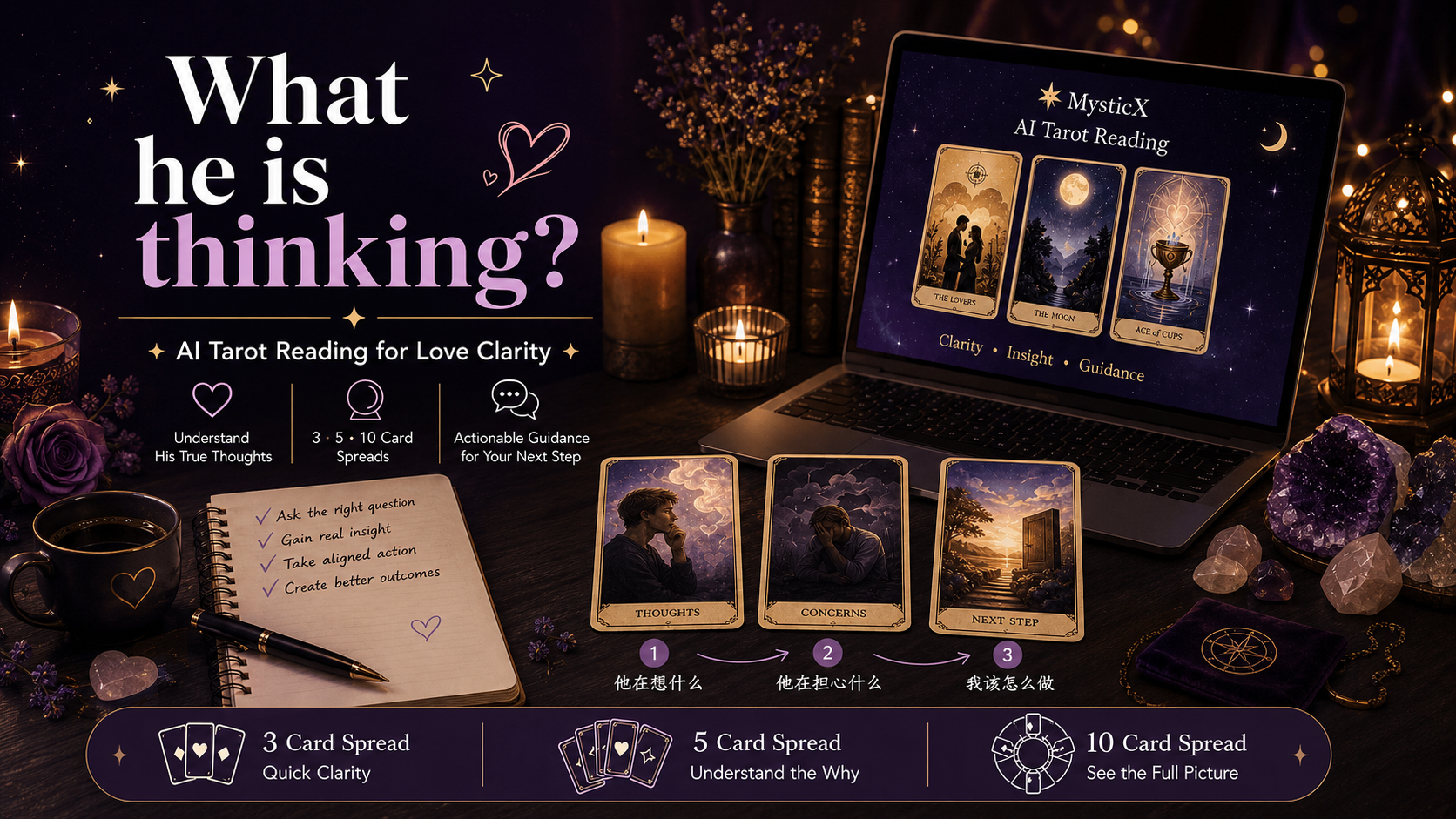
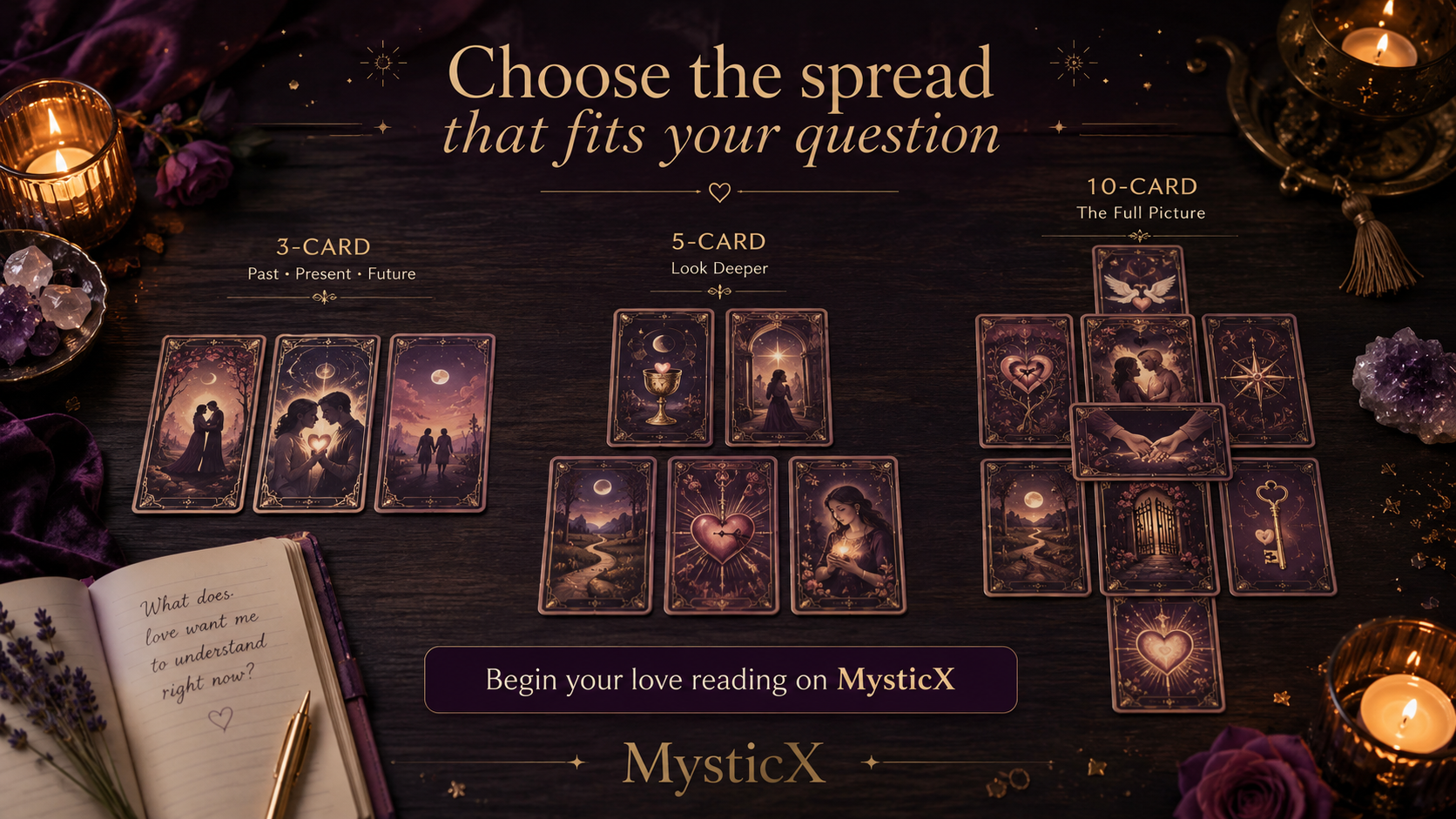
In this guide, I will use three tarot spreads, moving from light to deep:
-
3-card spread: a quick “mind-reading” version, best when you just need a first sense of the situation
-
5-card spread: a relationship breakdown, best when you want to understand the cause and possible direction
-
10-card spread: a deeper relationship reading, best when you want to see the full pattern
Along the way, I will also cover a few core reading styles you may want to try, including love tarot, Yes or No Tarot, and how to ask better questions so your reading becomes clearer and more useful.

First, Ask the Question the Right Way
A lot of tarot readings go sideways not because the cards are wrong, but because the question is too vague.
“What is he thinking?” is emotionally real, but as a tarot question, it is very broad.
If the question is vague, the answer is likely to feel vague too. Tarot works better when you give it a clear point of focus: the situation, the time frame, the stage of the relationship, and what has recently happened between you.
What helped me most was turning the question into something more readable.
Here are a few templates you can use directly.
Question Templates You Can Use
Template A: His thoughts
“In the next 14 days, what are his true thoughts about our connection?”
Template B: His intention
“In the next 14 days, what action is he most likely to take? Is he likely to reach out or move things forward?”
Template C: His hesitation
“What is the main reason he is hesitating right now, and what can I do to make the situation clearer?”
Notice that all three questions include a time frame. They also separate thoughts from actions.
That difference matters.
Some people think a lot but do very little. Some people do not say much, but they make plans, show up, and follow through.
Questions I Would Avoid
Some questions are not very helpful, especially with AI tarot, because they can pull you deeper into anxiety.
I would avoid questions like:
Invasive privacy questions
-
“Who is he flirting with right now?”
-
“Who is the third person?”
-
“What does she look like?”
Extreme prediction questions
-
“When exactly will we get married?”
-
“Will he definitely come back?”
Fate-based questions
-
“Is he my destined person?”
-
“Will he love only me forever?”
It is not that you are “not allowed” to ask these questions. It is that these questions tend to make you more attached to the answer.
They pull your attention away from:
What can I do?
And toward:
Can I control him?
That is usually where the spiral begins.
The Right Way to Use Yes or No Tarot
Yes or No Tarot can be very useful, but only for one type of question:
Action-based, testable, short-term questions.
For example:
-
“Should I message him today?”
-
“Should I ask to see him this week?”
-
“Should I bring up this issue clearly?”
The key is to give the question a short verification window, such as 48 hours or 7 days.
Otherwise, you can get trapped in the loop of asking again tomorrow because today’s answer did not feel good enough.

A 60-Second Preparation Before Using AI Tarot on MysticX
Do not rush straight into drawing cards.
When you are anxious, it is easy to mistake anxiety for intuition.
Before I use AI tarot now, I do a simple 60-second preparation. You can copy this exactly.
1. Set Your Environment and Mindset
Take three slow breaths.
Then write three short sentences about the relationship:
Recent interaction:
For example: “The last time we talked was three days ago, and he replied slowly.”
Your feeling:
For example: “I feel uneasy, and a little angry.”
Your goal:
For example: “I want to know whether I should keep moving forward or pull my energy back.”
Writing this down matters.
When you see the card interpretation later, you are less likely to be carried away by one dramatic line.
2. Set the Time Frame
This is how I usually think about it:
3 to 14 days:
Use this for current thoughts, attitude shifts, whether he may reply, or whether he may be open to meeting.
1 to 3 months:
Use this for relationship direction, real-life pressure, or whether the connection may become more stable.
If you ask “What is he thinking?” but stretch the reading six months or one year into the future, the result often becomes too abstract. There are too many variables.
3. Choose the Spread and Draw the Cards
For online tarot, you do not need to overthink the drawing method.
Random draw is enough.
What you are training is your intuitive response to the cards, not whether you somehow selected the “perfect” card.
4. Record Your First Reaction
After drawing the cards, take a screenshot of the card spread.
Before reading the AI interpretation, write down three words that come to mind immediately.
For example, I once saw a card and my first reaction was:
“Defensive. Torn. Wants to get closer but afraid to lose.”
Then, when the AI reading came through, I compared it with my first reaction.
A lot of the time, you realize you already knew half the answer.
5. Do Not Keep Drawing for the Same Question
If you draw cards for the same question three times in a row, what you are reading is often not the relationship anymore.
You are reading the shape of your anxiety.
Before you draw again, take one real action. Even a small one.
Send a low-pressure message. Pause for a day. Ask for a concrete time to talk.
Tarot becomes much more useful when it supports action instead of replacing it.
The 3-Card Spread: What He Is Thinking, What He Fears, What I Should Do Next
This is the spread I think works best for modern relationships.
It is quick. It is clear. And it does not drag you into emotional over-analysis.
When to Use This Spread
Use this spread when:
-
You are in the talking stage and the relationship is not clearly defined
-
You have had a cold period and want to know whether he regrets it or wants to soften
-
He is hot and cold, and you need a clearer sense of the energy
-
You only want to know what to do next, not spiral into mental drama
The Card Positions
You can use this layout directly:
Card 1: What he is thinking
His current thoughts or mental focus around you and the connection.
Card 2: What he is worried about or blocked by
The fear, hesitation, pressure, or emotional block behind his behavior.
Card 3: What I should do next
The best next step for you.
Be careful with the second card.
It is not necessarily “proof that he does not love you.” More often, it shows where he is stuck. Fear of responsibility. Fear of losing control. Fear of rejection. Real-life pressure. Avoidant habits.
Do not automatically read “fear” as “lack of love.”
How to Try This on MysticX
You can follow this flow:
- Open MysticX
- Choose Tarot Online
- Select a 3-card spread
- Enter your question and time frame
For example:
“In the next 14 days, what are his true thoughts about us? What is he worried about, and what should I do next?” - Draw your cards
- Read the AI tarot reading

Reading Tip: Thoughts Are Not the Same as Intentions
One mistake I often made was this:
I saw that he was conflicted, and I immediately translated it as, “He does not like me enough.”
But conflict can sometimes mean there are feelings.
It can also mean fear.
That is why the third card matters so much. The advice card shows the part you can actually work with. It shows where your choice can change the direction of the situation.
Action Checklist Based on the Advice Card
After your reading, try placing the advice card into one of these three action directions.
1. If the advice is about communication
Be direct, but do not interrogate.
Ask for facts, not emotional verdicts.
For example:
“Are you free to meet this week? I would like to talk in person and catch up.”
2. If the advice is about lowering pressure
Pull back a little.
Not as punishment. Not as silent treatment. Just to create space.
For example:
“I’ll be a bit busy these next two days. Let’s talk when you have more space.”
Then actually go live your life.
3. If the advice is about boundaries
Stop trying to date through guessing.
Put the basic expectation on the table.
For example:
“I am okay with moving slowly, but I do need basic response and respect. If that is not something you can offer, I will step back for now.”
The 5-Card Spread: How He Sees You, Why He Feels That Way, What He May Do, How You Should Respond, and the Outcome Trend
If the 3-card spread does not give you enough information, or if the relationship has history, the 5-card spread may be better.
It helps separate the cause from the behavior.
It also gives you a clearer sense of what part of the situation you can influence.
When to Use This Spread
Use this spread when:
-
The connection has been on and off
-
You feel there are things he has not said
-
You want to understand “why” and “what happens next”
-
You want a communication strategy, not just an answer
The Card Positions
Use this structure:
Card 1: How he sees you
His perception of you or how he currently experiences your energy.
Card 2: Why he sees you this way
The root cause behind that perception.
Card 3: What he is likely to do
His most likely action in the near future.
Card 4: How I should respond
Your best move.
Card 5: Outcome trend
The likely direction if the current energy continues.
Here is a useful rule:
The second card is the root cause.
The fourth card is your controllable variable.
The fifth card is a trend, not a final judgment.
Example Question for MysticX
For love tarot, I would write the question like this:
“In the next 14 days, how is he most likely to treat me, and how should I respond in a way that supports clarity?”
Then follow the flow:
Tarot Online → 5-card spread → enter your question and time frame → draw cards → read the AI interpretation
Reading Tip: Turn the Love Tarot Result into One Strategy Sentence
After a 5-card reading, I like to force myself to summarize the whole thing into one strategy sentence.
That way, I do not leave the reading more anxious than when I started.
Common strategy sentences might sound like:
-
“Confirm the boundary first, then talk about feelings.”
-
“Lower expectations for now and observe his actions.”
-
“Be specific about the issue instead of testing him emotionally.”
-
“Stop chasing the reason and first see whether he is willing to solve the problem with you.”
When you can turn the reading into one practical strategy, you start taking your power back.

The 10-Card Spread: A Mini Celtic Cross for His Inner Script and the Relationship Direction
A 10-card spread is not ideal when your emotions are exploding.
There is a lot of information. And when you are anxious, more information can turn into over-interpretation.
But if you are seriously thinking about the future, or if the relationship involves real-world pressure — long distance, a third party, family resistance, money, timing, or life plans — a 10-card spread can be very useful.
It does not only show “what he is thinking.”
It can show what he keeps repeating.
When to Use This Spread
Use this spread when:
-
You want to seriously talk about the future and stop staying in ambiguity
-
The relationship involves a third party, distance, family pressure, or practical obstacles
-
You need a full picture, not just one answer
-
You want to understand the pattern so you can decide whether to continue
Recommended 10-Card Structure: Mini Celtic Cross
You can use this layout:
Card 1: Current situation
The current state of the connection.
Card 2: Main obstacle
The core issue blocking the relationship.
Card 3: His surface thoughts
What he appears to think or show outwardly.
Card 4: His deeper motivation
What he truly wants underneath the surface.
Card 5: Past influence
A past event or old pattern affecting the present.
Card 6: Near future
What may happen in the next 2 to 4 weeks.
Card 7: Your position
Your current state and possible blind spot.
Card 8: External environment
Real-world pressure or other people’s influence.
Card 9: Hope and fear
The most conflicted part in either him or you.
Card 10: Outcome trend
The likely direction in the next 1 to 3 months.
How to Use This on MysticX
Before doing a 10-card spread, make your question more specific and use a longer time frame.
Do not only ask:
“Does he love me?”
That will often give you too many emotional phrases and not enough structure.
A better question would be:
“In the next 1 to 3 months, what is the most likely direction of this relationship? Where is his inner conflict, and what can I do to stay grounded?”
Then follow the flow:
MysticX → Tarot Online → 10-card spread → enter your question and 1 to 3 month time frame → draw cards → read the AI interpretation
Reading Framework: Look at the Elements First, Then the Major Arcana
When you receive a 10-card reading, start with a quick scan.
Many Wands:
Impulse, desire, fast movement, passion, but possibly instability.
Many Cups:
Strong feelings, sensitivity, imagination, emotional attachment.
Many Swords:
Heavy thinking, conflict, defensiveness, communication that may cut or hurt.
Many Pentacles:
Practical concerns, stability, slow development, or a focus on real-world cost and responsibility.
Then look at the Major Arcana.
If there are many Major Arcana cards, this may be a relationship that carries a larger life lesson. It may teach you something important, but it may also push you to grow in uncomfortable ways.
How to Avoid Information Overload
For a 10-card reading, I suggest summarizing the result into three sections:
1. What is his inner conflict?
Write it in one sentence.
2. What are three things I should do?
Make them practical and specific.
3. What is one behavior I need to stop?
Something you keep doing that may be making the situation worse.
This keeps you from being pulled around by the outcome card. Instead, you use the reading to make a clearer decision.
Yes or No Tarot: When You Only Need to Know Whether to Act Now
Sometimes you do not need 10 cards.
Sometimes you only need one direction.
For example, you already wrote the message. Your finger is on the send button. You just want to know:
Should I send it or not?
That is when Yes or No Tarot can be useful.
Good Questions for Yes or No Tarot
-
“Should I message him today?”
-
“Should I ask to see him this week?”
-
“Should I clarify this issue directly?”
Questions That Do Not Work Well
-
“Is he my soulmate?”
-
“Will he love me forever?”
-
“Is he destined to come back?”
These questions are hard to verify. They can pull you into a sense of fate, and then you may feel like you cannot do anything.
A Better Way to Ask
Turn the question into a two-option action question and set a time frame.
For example:
“Within the next 48 hours, which choice is better for moving this connection forward: A, sending the message, or B, not sending the message?”
How to Read the Answer
Yes or No gives you a direction, but you still need to pay attention to the condition shown by the card.
For example, the answer may lean yes, but the card may also suggest that the message should be softer.
That means: do not send a long emotional accusation.
Send something short, light, and open enough for the conversation to continue.
My Favorite Combination
I often use this combination:
First, use Yes or No Tarot to decide the action.
Then use a 3-card spread to understand how to take that action more wisely.
You may notice that your anxiety drops a lot.
Because you are no longer trying to spy on his mind.
You are calibrating your own next move.

Turning an AI Tarot Reading into Real Communication: 3 Traps That Make People More Anxious
The biggest risk of AI tarot reading is not that it is “wrong.”
The bigger risk is treating it like a surveillance tool.
Here are three traps I have fallen into myself.
Trap 1: Reading His Hesitation as Rejection
His hesitation may come from practical pressure. It may come from fear of responsibility. It may come from an avoidant relationship pattern.
The answer is not necessarily to draw more cards.
The answer is to verify through action.
Send one message. Ask to meet once. See how he responds.
Trap 2: Only Looking at the Outcome Card
Many people stare at the final card. If the outcome looks unstable, they collapse emotionally.
But in relationships, the real variable is often the advice card.
That is the part you can work with.
Can you speak clearly? Can you set a boundary? Can you stop testing him emotionally? Can you stop trying to guess what he refuses to say?
Trap 3: Using Tarot as a Monitoring Tool
Frequent readings can weaken your intuition and judgment.
You may start trusting the next card more than your own feelings.
A better replacement is something very practical:
Write a low-pressure message.
Use three principles:
-
Do not interrogate
-
Give him a choice
-
State your boundary
For example:
“I have been thinking about you, and I would like to understand where we are. Are you free this week to talk for ten minutes in person? If you do not want to talk right now, you can tell me directly. I will respect that.”
This message does not judge him. It does not demand private details. But it does place the boundary on the table.
After every reading, take one small action.
Send a message. Set a time. Pause the chase. Observe the response.
Do not draw again immediately.
If You Use MysticX for Love Tarot: A Reusable Flow from Light to Deep
Here is the full process I would use again and again.
Whether you want to ask “What is he thinking?” or do a broader love tarot reading, this structure works.
Flow 1: Quick Check
3-card spread → thoughts / worries / advice → take one small action
Use this when you only need a clear first read and do not want to make things too complicated.
Flow 2: Medium Depth
5-card spread → find the root cause → adjust your communication strategy → observe for two weeks
Use this when there is repeated push and pull, and you want to understand the cause and direction.
Flow 3: Deep Relationship Reading
10-card spread → understand the pattern and real-world pressure → make a boundary or planning decision over 1 to 3 months
Use this when you are facing a bigger decision, such as whether to enter a serious relationship, keep waiting, or stop investing in something that is draining you.
When to Use a Deeper Spread
Move from 3 cards to 5 or 10 cards when:
-
The 3-card reading does not give you enough clarity
-
The same pattern keeps repeating, such as “he avoids, you chase”
-
You need to make a significant decision and want a fuller picture
When to Stop Reading
Stop drawing cards when:
-
You are emotionally overwhelmed and only using the reading to calm anxiety
-
You have asked the same question more than three times
-
You do not plan to take action and only want an answer that makes you feel better
Stopping can also be a form of strength.
Really.

Final Thoughts: You Do Not Only Want to Know What He Is Thinking. You Want to Know What You Should Do Next Without Losing Yourself.
In the end, “What is he thinking?” is only the doorway.
The real question underneath it is usually:
What can I do next so I do not abandon myself?
You can remember the value of the three spreads this way:
3 cards help you set the tone.
5 cards help you understand the cause and effect.
10 cards help you see the whole pattern.
If you want to begin, use Tarot Online to turn anxiety into action and boundaries.
Set a time frame. Choose one spread. Ask one specific question. Take one small action. Then record what happens.
Start lightly.
You can go to MysticX now and choose a spread. Begin with 3 cards. Do not try to solve the entire relationship in one reading. Just ask for a little more clarity today.
Over time, you may notice something surprising:
You ask fewer questions.
But your actions become more accurate.
FAQs
What is an AI tarot reading online?
An AI tarot reading online uses artificial intelligence to interpret tarot cards you draw digitally. It can help you explore relationship questions, emotional patterns, and possible next steps through structured card meanings and personalized guidance.
How can I use MysticX for a love tarot reading?
On MysticX, you can choose different tarot spreads depending on your question. A 3-card spread is useful for quick clarity, a 5-card spread can help you understand the relationship dynamic, and a 10-card spread is better for deeper patterns and longer-term direction.
Can AI tarot tell me what he is thinking?
AI tarot cannot directly read someone’s mind. What it can do is help you explore the emotional energy, possible motivations, blocks, and relationship patterns around the situation. It is best used for insight and next-step guidance, not as a final verdict.
How should I ask a question to get a clearer tarot reading?
Avoid vague questions like “What is he thinking?” and turn them into specific, time-framed questions. For example: “In the next 14 days, what are his true thoughts about our connection, and what should I do next?”
Can I use tarot if the relationship feels unsafe?
If there are signs of manipulation, threats, violence, stalking, or any serious safety risk, prioritize real-world support first. Reach out to trusted people or professional services. Tarot should never be used to talk yourself into staying in an unsafe situation.
What is the difference between a 3-card, 5-card, and 10-card spread?
A 3-card spread is best for quick clarity. A 5-card spread helps you break down the relationship dynamic, including causes and likely actions. A 10-card spread gives a fuller view of deeper patterns, external pressure, and longer-term direction.
Is AI tarot accurate for relationship questions?
AI tarot can offer useful reflection and emotional insight, especially when your question is specific and grounded. However, it should not replace honest communication, real-world observation, or your own judgment. Use it as a support tool, not as the only source of truth.

Related Posts

Love Tarot: Will This Situationship Become a Real Relationship?
Is your situationship becoming something real, or are you waiting for a future that may not come? This Love Tarot guide helps you explore feelings, commitment, and relationship clarity.
Love Tarot: Should I Text Him First?
Should you text him first? This Love Tarot guide helps you understand silence, mixed signals, timing, and whether reaching out will bring clarity or deepen anxiety.

Love Tarot: Is This Casual Relationship Just Physical?
Is this casual relationship just physical, or is there something deeper? This Love Tarot guide helps you explore attraction, feelings, mixed signals, and emotional clarity.