

What is your soul trying to tell you?
You know that feeling when nothing is technically wrong… but something feels off.
Like you’re moving through your days, doing the normal stuff, replying to messages, showing up to work, being “fine”. And yet there’s this quiet pressure under the surface. A nudge. A pull. Sometimes it’s more like a dull ache. Sometimes it’s a sudden spark of excitement that makes no logical sense.
That’s usually what people mean when they say, “I feel like my soul is trying to tell me something.”
Not in a spooky way. More in a human way.
It’s intuition. It’s patterns you keep repeating. It’s unresolved emotions you keep stepping around. It’s your values asking to be honored. It’s the part of you that notices what your mind keeps rationalizing.
And this is where Tarot tends to work surprisingly well.
Tarot is a mirror. It doesn’t force a fate. It doesn’t magically decide your future for you. It gives you symbols. Friction. A storyline to react to. And in that reaction, you often hear yourself more clearly than you have in weeks.
Also, Tarot online has exploded for very practical reasons.
Privacy, for one. Speed. Consistency. It’s easier to journal and revisit your pulls instead of trying to remember what a reader said in the moment. And honestly, sometimes you just want clarity at 1:00 a.m. without having to explain your life to anyone.
In this article, you’re going to learn how to read the signal your soul is sending, how to use a free tarot reading responsibly, and why AI tarot can be genuinely helpful when it’s used the right way. Not as a crutch. More like… guided reflection with structure.
Why “your soul” keeps nudging you (and why Tarot works so well online)
Let’s make “soul messages” less mystical and more usable.
Most soul messages are one of these:
- Intuition you’ve been ignoring: you already know, you just don’t want the inconvenience of knowing.
- A pattern asking to be interrupted: dating the same person in a different outfit. Burning out again. Overgiving again.
- An emotion that needs air: grief, anger, shame, longing. Stuff that gets louder when it’s never named.
- A value that wants to be lived: freedom, honesty, peace, creativity, stability. Your life might look fine, but it doesn’t match what matters to you.
- A decision that’s ripening: you’re stalling because either choice changes your identity a little.
Tarot helps because it bypasses your usual mental loops. You draw a card, you see an image, and you feel something. Resistance, relief, curiosity, annoyance. That emotional response is data.
And doing Tarot online makes it easier to catch that data.
You can pull, read, journal, save it, come back later, see what changed. The distance helps. The consistency helps. The ability to revisit helps a lot, actually.
Just keep your expectations clean: Tarot is not a judge. It’s not a courtroom verdict. It’s a mirror that helps you name what you already sense.
The real problem with most “free tarot reading” sites (and how to avoid getting a generic reading)
A lot of free tarot reading sites are… kind of the same.
You click a card. It spits out a paragraph that could apply to literally anyone. Then it scares you a little. Then it nudges you toward an upgrade. Or it drops a dramatic line like “someone is deceiving you” with zero context, and now you’re spiraling.
Common issues you’ll see:
- Vague, copy paste meanings that never mention your actual question
- Fear based wording that makes you anxious so you keep clicking
- Aggressive upsells that interrupt the reading
- No memory or context so every reading feels disconnected and generic
- No real next step, just “trust the universe” and you’re left hanging
A good online Tarot experience should feel different. It should include:
- Help framing a clear question
- Actual card images (not just names)
- Interpretation that relates to your situation
- A gentle tone that doesn’t do doom language
- Actionable reflection prompts so you can do something with it
- Ideally, the ability to save the reading so you can revisit it later
Quick checklist before trusting an online reader:
- Does it explain what spread you’re using?
- Does it connect the meaning to your question, not just generic keywords?
- Does it avoid “you will definitely” statements?
- Does it avoid scary absolutes and manipulation?
- Can you save or revisit the reading?
Because yes, AI tarot can be useless. Or it can be shockingly insightful.
It depends how it’s built.
AI tarot vs traditional tarot: what’s actually different?
AI tarot is simple to define.
You draw cards (digitally), you type your question and context, and the AI interprets the cards into a structured reading. That’s it.
What AI can do well:
- Personalized summaries that reflect your question and wording
- Pattern detection across multiple pulls, especially if you save your history
- Journaling prompts that push you past surface level meanings
- Consistent tone, which matters more than people think
- Fast clarity when you’re stuck in rumination
What AI cannot do:
- Replace your discernment
- Guarantee outcomes
- Make decisions for you
- Substitute professional mental health support
- Handle medical or legal certainty responsibly (it shouldn’t even try)
The best way to think of AI tarot is: guided reflection.
You bring the real life context. Tarot provides symbols. AI helps translate symbols into language, questions, and next steps.
And this is why I recommend MysticX.AI specifically. It’s built to feel like guided, practical readings. Not just a random tarot generator dumping generic text at you.
Start here: ask the right question (this determines the quality of your reading)
The quality of your question matters more than the cards.
Vague question equals vague answer. Every time.
A strong Tarot question is usually:
- present focused
- actionable
- honest (even if it’s uncomfortable)
- aimed at clarity, not control
Here are six question templates that work really well:
- “What am I not admitting to myself about ___?”
- “What pattern keeps repeating in my relationships or career right now?”
- “What is the next best step for me this month?”
- “What energy should I embody to move forward?”
- “What am I ready to release?”
- “What am I learning through this challenge?”
And here are four weak questions to avoid, plus better rewrites:
- “Will they come back?”
- Better: “What do I need to know about this connection right now?”
- “Is this person my soulmate?”
- Better: “What is the lesson and potential of this connection, and what do I need to stay grounded?”
- “Will I get the job?”
- Better: “How can I strengthen my chances, and what should I focus on in my approach?”
- “When will things get better?”
- Better: “What is within my control right now to create relief and momentum?”
One quick safety note, because it matters.
Avoid using tarot for medical, legal, or financial certainty. Don’t ask it to diagnose you, tell you if you should stop medication, or guarantee court outcomes. Use tarot for clarity, perspective, choices, and emotional truth. That’s where it shines.
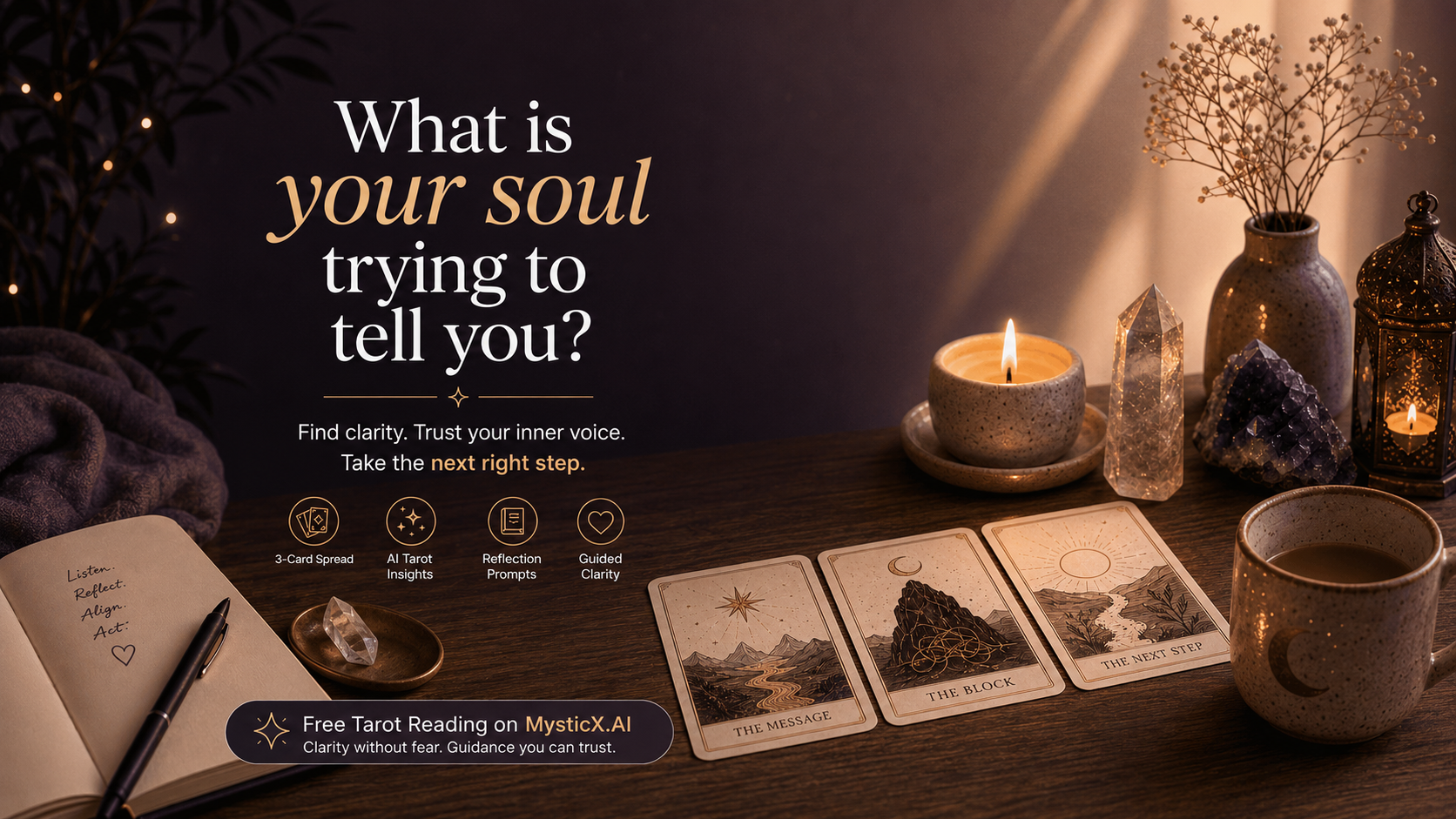
A simple 3-card spread for “What is my soul trying to tell me?”
If you only learn one spread, make it this one. It’s beginner friendly, balanced, and it works beautifully online.
The “Soul Message” 3-card spread
Card 1: The message
What your inner self wants you to notice right now.
Card 2: The block
What is getting in the way of hearing or honoring that message.
Card 3: The next step
One practical move that aligns you with the message.
That’s it. Simple, repeatable, not overwhelming.
Tips for better pulls online (this is the part people skip, then wonder why it feels messy):
- Take one slow breath before you draw. Seriously.
- Set a clear intention. One sentence is enough.
- Don’t over pull. Three cards means three cards.
- Write notes. Even messy notes.
- Revisit after 24 hours and see what hits differently
You can do this as a free tarot reading on MysticX.AI and save the results, which makes the “revisit later” part actually doable.
How to use MysticX.AI (recommended) for a clear, non-generic AI tarot reading
If you want an AI tarot reading that doesn’t feel like copy paste fluff, here’s what to look for during the process:
- Can you choose a spread?
- Can you add context, not just a question?
- Can you pick a tone (gentle vs direct)?
- Does the output come structured, with prompts and next steps?
A high level flow that works well:
- Go to MysticX.AI
- Choose a reading type or spread (start with a 3-card spread)
- Write your question plus 2 to 3 lines of context
- Draw your cards
- Read the interpretation and reflection prompts
- Save it, then journal your takeaways in your own words
Why MysticX.AI tends to feel more useful than random tarot generators:
- It leans into contextual interpretation, not generic keywords
- It gives reflection prompts so you can go deeper without spiraling
- It nudges you toward practical next steps
- Less fluff, less doom language, more “what do we do with this”
A “best results” input formula you can steal:
Situation + emotion + constraint + desired clarity
One to four sentences.
Example:
“I’m thinking about leaving my job, but I’m scared I’m being impulsive. I feel restless and tired all the time. I can’t afford a long gap in income. What’s the next best step for me this month?”
That kind of input gives the reading something to work with.
If you want fast clarity without doom-y language, try a free tarot reading on MysticX.AI and save the pull. It’s the saving part that turns it from entertainment into something you can actually learn from.
How to interpret the cards like a human (even when AI gives you the meaning)
Here’s the core skill: connect symbols to your real life.
Do not treat Tarot meanings as fixed fortune. Treat them like prompts.
A quick interpretation framework that works with any card:
- Literal scene: What’s happening in the image?
- Emotion: What does it make you feel, instantly?
- Where it shows up: What part of your life matches that feeling?
- Smallest action: What’s one tiny move you can make today?
That last part is everything. Your soul usually speaks in simple actions, not dramatic life overhauls.
Reversals (optional)
If you use reversals, don’t treat them as “bad.” A reversal can mean:
- blocked
- delayed
- internal
- unconscious
- overdone or underdone energy
Major vs Minor Arcana
- Major Arcana: big life lessons, identity shifts, “this matters” energy
- Minor Arcana: day-to-day patterns, choices, habits, relationships, mood
Suits in one line each
- Cups: feelings, relationships, intuition
- Swords: thoughts, communication, conflict, clarity
- Wands: drive, desire, creativity, momentum
- Pentacles: body, work, money, stability, routines
What your soul might be saying (common themes that show up in online tarot readings)
People ask wildly different questions, but the themes repeat. Here are a few that show up constantly, especially in online tarot readings.
Theme 1: “Slow down and feel it”
Often shows up as: Cups, The High Priestess, The Moon
Signs this is your message:
- you’re rushing decisions because stillness feels scary
- you keep distracting yourself, even with “productive” things
- your body is tense and you can’t explain why
Journaling prompts:
- What feeling am I avoiding by staying busy?
- What truth do I already know but don’t want to say out loud?
- Where do I need to trust my timing instead of forcing it?
Small action:
- Take 10 minutes today with no input. No phone, no music. Just sit. Then write one sentence: “What I really feel is ___.”
Theme 2: “Choose yourself”
Often shows up as: Strength, The Empress, Queens (especially Queen of Wands or Cups)
Signs this is your message:
- you’re over explaining your boundaries
- you’re doing emotional labor for people who don’t meet you halfway
- you keep shrinking to keep peace
Journaling prompts:
- Where am I abandoning myself to be loved?
- What boundary would make my life feel lighter immediately?
- What would I do if I trusted my worth was not negotiable?
Small action:
- Say no to one thing this week that you usually say yes to out of guilt. One thing. Clean and simple.
Theme 3: “Speak the truth”
Often shows up as: Justice, Ace of Swords, King of Swords
Signs this is your message:
- you’re carrying resentment because you’re not being honest
- you keep hinting instead of stating
- you’re afraid the truth will “ruin everything”
Journaling prompts:
- What conversation am I avoiding, and what is it costing me?
- What’s the cleanest, kindest truth I can say?
- If I spoke honestly, what would I be asking for?
Small action:
- Draft the message or talking points. Don’t send yet if you’re not ready. But write it with full honesty, then trim it down to the clean version.
Theme 4: “Build the new life quietly”
Often shows up as: Pentacles, Temperance, The Hermit
Signs this is your message:
- you want transformation, but you’re allergic to consistency
- you start big, burn out, then shame spiral
- you’re comparing your pace to other people
Journaling prompts:
- What would progress look like if it was boring?
- What one habit would change everything in 90 days?
- Where am I craving intensity because I don’t trust steady growth?
Small action:
- Pick one tiny routine that supports your future self. 15 minutes a day. No drama. Just do it for seven days.
How to get a “free tarot reading” without getting addicted to readings
The trap is real.
Repeated pulls for reassurance lead to more anxiety, not clarity. You pull again because you didn’t like the answer. Then you get a different card. Now you’re confused. So you pull again. Suddenly it’s been 45 minutes and you trust yourself less than when you started.
Some rules that help:
- One question per day or per week, depending on how anxious you get
- Use the same spread for up to 7 days max (don’t keep changing the method)
- Reflect before you re-ask. Journal first, then decide if you even need another pull
A healthier way to use tarot as a decision aid:
- Define two options clearly (Path A, Path B)
- Define your values (peace, growth, stability, freedom, etc.)
- Pull cards for “energy of Path A” and “energy of Path B”
- Choose consciously. Tarot supports the decision, it does not replace it.
Also, grounding matters more than another reading: Sleep. Hydration. A walk. Talking to a trusted person. Therapy when needed.
MysticX.AI works best when you use it as structured reflection. Save readings. Track patterns. Don’t just scroll endlessly hunting for the “right” answer.
A 7-day “soul message” practice (quick routine you can actually stick to)
Here’s a routine that’s simple enough to do even when life is busy and your brain is loud.
Day 1: Set intention + one question
Write one sentence: “This week, I want clarity about ___.”
Day 2: Do the 3-card spread + write 5 bullet takeaways
No essay. Just bullets. What stands out, what stings, what feels true.
Day 3: One small action
Do one thing from Card 3 (the next step). Keep it small on purpose.
Day 4: Notice patterns
What showed up in your day that matched the reading? A conversation, a trigger, a feeling.
Day 5: Revisit the saved reading
Read it again with fresh eyes. Add one new note.
Day 6: Values check
Ask: “What choice matches who I want to be?” Not who you were. Not who others expect.
Day 7: Close the loop
Summarize the week in a short paragraph. Then decide one commitment for the next week.
Doing Tarot online with MysticX.AI makes this easier because you can keep consistent prompts and saved history. And the whole point of this practice is consistency. Not intensity.
Let’s wrap up: your soul’s message is usually simple (even if your mind isn’t)
Your soul usually isn’t yelling some complicated riddle.
It’s more like a quiet, repetitive sentence you keep hearing in different forms.
Tarot helps you hear what you already know. Then it asks you to act on it, gently but for real.
If you want a clean way to do this:
- Ask a better question
- Use the 3-card “Soul Message” spread
- Interpret with your actual life context
- Take one real world action, even a small one
And if you want clarity with structure and a calmer tone, try a free tarot reading on MysticX.AI. Save it. Revisit it. Let it become a conversation with yourself, not a slot machine for reassurance.
Last question, and sit with it for a second:
If your soul could only say one sentence to you today, what would it be?
FAQs (Frequently Asked Questions)
What does it mean when I feel like my soul is trying to tell me something?
This feeling usually refers to intuition—a subtle inner signal indicating patterns you're repeating, unresolved emotions, values seeking acknowledgment, or decisions you’re stalling on. It's a human experience of sensing that something beneath the surface needs your attention.
How can Tarot readings help me understand these soul messages?
Tarot acts as a mirror by providing symbolic images and narratives that bypass your usual mental loops. Your emotional reactions to the cards—such as resistance or curiosity—offer valuable data, helping you name and clarify what you already sense internally.
Why is online Tarot reading becoming popular and how is it beneficial?
Online Tarot offers privacy, speed, consistency, and convenience. It allows you to journal, save, and revisit your readings anytime—ideal for moments when you need clarity without explaining your life to someone else. The distance and ability to reflect over time enhance insight.
What should I watch out for when using free online Tarot reading sites?
Many free sites provide generic, vague interpretations that lack personal context, use fear-based language to upsell services, offer no continuity between readings, and fail to give actionable next steps. These factors can lead to anxiety and confusion rather than helpful guidance.
What makes a good online Tarot reading experience?
A quality online Tarot reading helps you frame clear questions, shows actual card images with interpretations relevant to your situation, uses gentle and non-doom language, provides actionable reflection prompts, and ideally lets you save readings for future reference.
How does AI Tarot differ from traditional Tarot readings?
AI Tarot involves digitally drawing cards and entering your question so the AI interprets the cards into a structured reading. It excels at providing personalized summaries reflecting your wording but depends heavily on how well it's designed. Unlike traditional readers, AI offers consistency and accessibility but lacks human intuition nuances.

Related Posts
Love Tarot: Will This Situationship Become a Real Relationship?
Is your situationship becoming something real, or are you waiting for a future that may not come? This Love Tarot guide helps you explore feelings, commitment, and relationship clarity.
Love Tarot: Should I Text Him First?
Should you text him first? This Love Tarot guide helps you understand silence, mixed signals, timing, and whether reaching out will bring clarity or deepen anxiety.
Love Tarot: Is This Casual Relationship Just Physical?
Is this casual relationship just physical, or is there something deeper? This Love Tarot guide helps you explore attraction, feelings, mixed signals, and emotional clarity.