

How to use Tarot for love divination
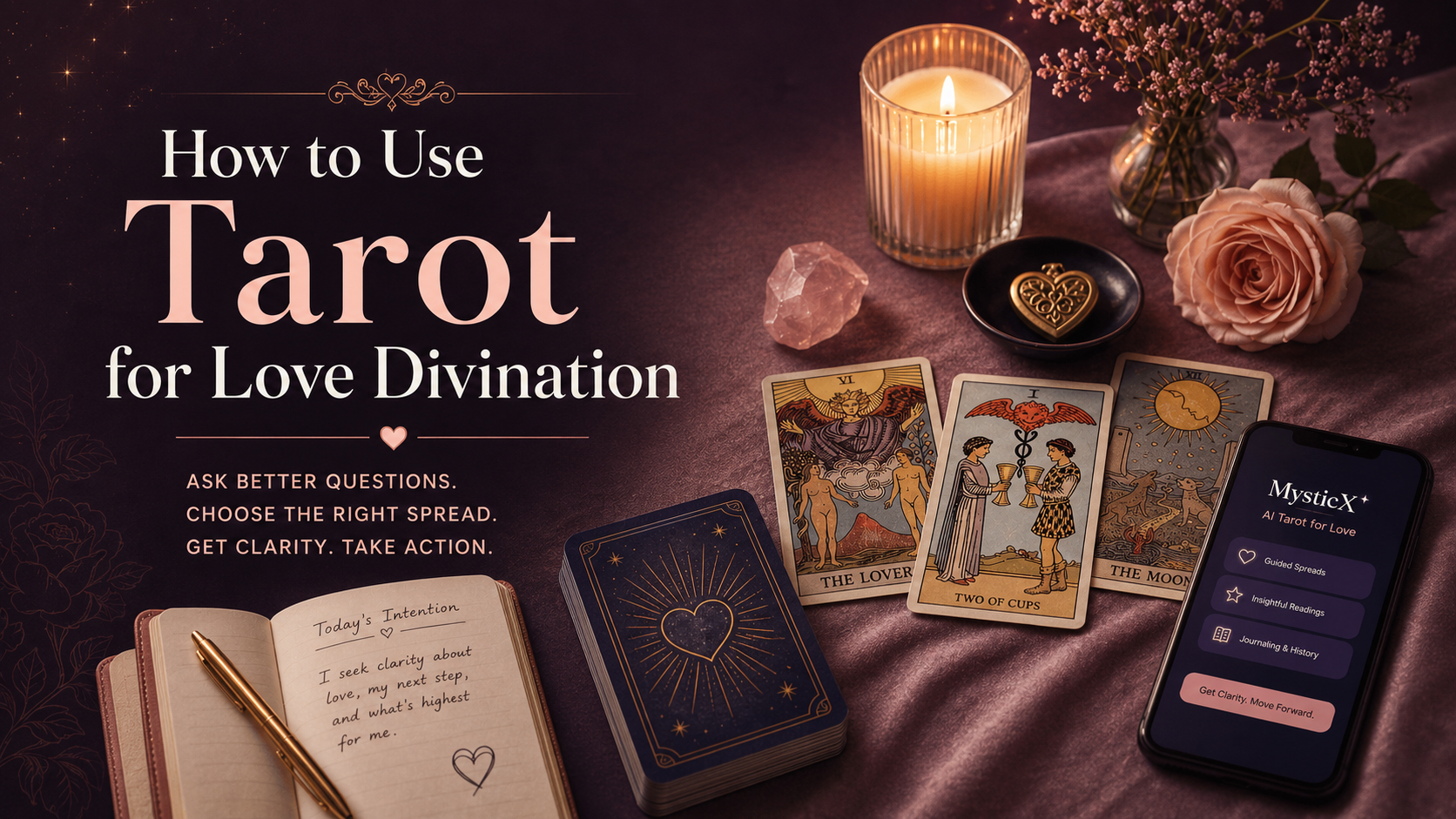
Why love tarot still works (and why most people do it wrong)
Love tarot works for the same reason journaling works. And therapy. And that one brutally honest friend who somehow sees the pattern before you do.
Tarot is an insight tool. It helps you notice dynamics, blind spots, repeating loops, and the emotional weather in a connection. It can show you what is likely if nothing changes. It can also show you what changes if you change something.
What it is not.
It is not mind control. It is not a guarantee. It is not a cosmic permission slip to chase someone who already said no. And it is definitely not a machine that spits out one perfect prediction if you just pull enough cards.
Most people do love tarot wrong in a few predictable ways:
- They only ask yes or no questions. And then they get frustrated when the answer is fuzzy. Tarot is symbolic. It speaks in stories, not in binary switches.
- They read while emotionally flooded. Like right after a fight, or after seeing a “seen” message, or at 2:00 a.m. in full spiral mode. In that state, you will project. Hard.
- They ignore context. A card meaning changes depending on the relationship stage, your history, the actual behavior on the ground.
- They pull too many cards until they get the answer they want. This is the big one. That is not divination, that is anxiety management.
So when I say “love divination” in this article, I mean something more grounded and useful:
- understanding feelings, intentions, and fears
- understanding the current dynamic between you
- spotting communication blocks
- noticing timing windows, not fixed dates
- figuring out your best next move
Also, quick note on AI tarot. It can be genuinely helpful, especially for structure, consistency, and keeping you from turning your spread into random card soup. But it still depends on you asking good questions and being honest about what the situation actually is.
Which brings me to the fastest way to do this well.
Start here: use MysticX for fast, structured love readings (AI tarot)
If you want a clean, structured love tarot reading without getting lost in interpretation or pulling 19 clarifiers, start with MysticX.
I’m recommending it upfront because love readings are where people get messy. MysticX helps keep things contained and repeatable. You can run consistent spreads, get guided prompts, and end up with summaries that are easy to journal and compare later.
Why it’s useful for love tarot, specifically:
- Quick spreads that stay on-topic, instead of wandering.
- Guided prompts, which makes your question tighter.
- Consistent interpretations, so you can track patterns over time.
- Journaling friendly output, making it easier to document your readings, so you can actually use the reading instead of just feeling it.
How to use MysticX in a non generic way
The difference between a spooky accurate reading and a vague one is usually… context. Not magic.
When you use MysticX, write your situation like you are briefing someone who is smart but not inside your head. Include:
- relationship stage: first dates, committed, on and off, separation, no contact, situationship
- timeframe: next 7 to 14 days, this month, next 30 days
- what you want to understand: his intentions, emotional availability, why communication changed, whether to initiate contact, etc
Example (good context input):
“We have been dating for 6 weeks. Chemistry is strong but texting is inconsistent, he disappears for 1 to 2 days sometimes. No exclusivity talk yet. I want to know his intention and what is blocking consistent communication. Timeframe: next 14 days.”
That alone makes the reading sharper.
What to Ask So the Output Does Not Get Vague
Focus on aspects that tarot can reflect clearly:
- Feelings: What emotion is present, what is avoided
- Fears: What they are protecting themselves from
- Intentions: What they are leaning toward doing
- Blocks: What stops action
- Communication: What is unsaid, what needs to be said
Instead of asking “Will he come back?”, try reframing it to “What would make reconnection realistic, and what would make it unlikely?”
How to Validate the Output (This Part Matters)
Treat the reading like a draft hypothesis and then check it against reality:
- Does it match what he actually does, not what he says?
- Do you have behavioral evidence?
- Can it help you plan a conversation, set a boundary, or make a decision?
If a reading suggests “he wants commitment” but he has not asked one question about your life and only texts after 11 p.m., you have your answer. Reality is louder than tarot.
Ethical Use, So You Do Not Spiral
Love tarot can become addictive when used like a slot machine.
Set a cadence. Seriously. For the same situation, do once per week max or once every 10 days. Especially if you tend to overthink.
If you feel yourself wanting to check again today because the card “felt scary,” that is your sign to pause. Tarot should reduce anxiety, not produce it.
Additionally, it's important to remember that while tarot can provide insights into feelings and intentions, it's equally vital to prioritize self-care and set healthy boundaries.
Before you pull cards: set your intention and define the love situation
If you want love divination that actually helps, you need to define what “love situation” you are in. Otherwise every reading becomes “maybe”
Pick one context:
- Dating
- Committed relationship
- Separation or breakup
- No contact
- Crush
- Situationship, the category that creates more tarot questions than all the others combined
Then choose a timeframe. Shorter timeframes keep you honest:
- “next 7 to 14 days”
- “this month”
- “next 30 days”
Long timeframes like “this year” are where fantasy lives. Sometimes that is fine. Usually it is not helpful.
Now decide what you actually want from the reading:
- clarity
- reconciliation potential
- emotional availability
- best next step
- whether to initiate a conversation
- whether to stop investing
A simple grounding ritual that takes 60 seconds
Do this before any love reading, especially if you are activated:
- Inhale slowly for 4 seconds, exhale for 6. Do that 5 times.
- Write one sentence intention.
Example:
“I want clarity about what is happening between us and what my best next step is, without forcing an outcome.”
That sentence alone reduces projection.
Create a signal vs noise rule
A small rule that saves you from bad readings:
If you are triggered, do the spread. But do not interpret it immediately.
Take a photo. Save the MysticX summary. Come back later when your nervous system is not driving the bus.
Ask better love questions (including “what is he thinking?”)
There are empowering love questions and there are draining ones.
Draining questions feel like this:
- “Does he love me”
- “Will he choose me”
- “When will he text”
- “Is he my soulmate”
- “Is he thinking about me right now”
Not because they are evil. Because they put you in a passive position. They also tend to produce ambiguous answers, which makes you pull more cards.
Empowering questions sound like:
- “What is the dynamic between us right now”
- “What is he ready for, emotionally”
- “What is blocking clear communication”
- “What do I need to know that I am avoiding”
- “What is the healthiest next move for me”
Reframing “what is he thinking” into questions tarot can answer
You can absolutely ask “what is he thinking” but give it a structure. Thoughts alone are slippery. Pair them with intention and action.
Try these:
- “What is he thinking about us right now”
- “What feelings are underneath his current behavior”
- “What is he intending to do next”
- “What is he avoiding saying”
- “What does he want but will not admit”
- “What fear is driving his hesitation”
- “What kind of connection does he believe this is”
Add context constraints (this makes readings way more accurate)
Add:
- timeframe: “in the next 7 days”
- channel: “in communication through texting” or “in person”
- goal: “I want closure” or “I want reconnection”
Example:
“In the next 14 days, what is he likely to do about communication with me, and what is blocking him from being consistent”
When not to ask
Do not use tarot to override a boundary.
If he said he does not want a relationship. If he ghosted. If there is clear disrespect. Tarot is not here to help you negotiate with reality.
Also do not ask tarot for permission to ignore red flags. You already know the red flags. That is why you are reading this.
Choose the right love spread (simple to advanced)
Spreads matter because they force the reading into roles. They prevent you from staring at three cards and making them mean thirty different things.
They also make your readings comparable over time. Which is huge if you are trying to see whether things are improving or you are just hoping.
1 card clarity pull
Use this when you are tempted to do a full reading but you are emotionally tired.
Prompts:
- “Energy between us today”
- “Best next step for me”
- “What should I focus on in this connection this week”
One card. Then stop.
5 card “what is he thinking” spread
This is the one I use the most for mixed signals.
- His thoughts
- His feelings
- His intention
- What blocks him
- Likely next action
It gives you a full picture without turning into a novel.
7 card relationship path spread
Use this when you need the bigger storyline.
- Past influence
- Present dynamic
- Hidden factor
- Advice
- External influence
- Near term outcome
- Best choice for you
Notice that last position. Best choice for you. Not best way to get him.
How MysticX helps here
With MysticX, you can run the same spread the same way, save it, and compare later. That consistency is the whole point.
A lot of “tarot accuracy” is just you being able to track what actually happened after the reading.
The love tarot card meanings that matter most (without memorizing a whole book)
You do not need to memorize every card. For love divination, think in terms of relationship function.
Ask: what does this card do in a relationship?
- Does it bring commitment or avoidance
- attraction or confusion
- conflict or healing
- stability or instability
- honesty or secrecy
Core archetypes that show up a lot in love readings
The Lovers
Choice, alignment, values. Sometimes it is romance. Sometimes it is the moment where someone has to choose maturity.
Two of Cups vibe
Mutual affection, emotional reciprocity, actual bonding. Not just chemistry.
The Devil
Attachment, obsession, temptation, power dynamics. Can be sexual magnetism. Can be unhealthy loops.
The Tower
Truth revealed, disruption, sudden shifts. Sometimes a breakup. Sometimes the end of denial.
Temperance
Healing, patience, emotional blending, slow trust building. A green flag card, but it asks for moderation.
The Moon
Uncertainty, projection, hidden info, mixed signals. Not always lies. But rarely clarity.
The Empress and The Emperor
Empress: nurturing, openness, receiving, abundance.
Emperor: structure, protection, leadership, commitment.
In shadow forms, Empress can over give, Emperor can control.
Suit shortcuts that actually help
Wands: chemistry, pursuit, desire, the chase.
Great for passion. Also the suit of inconsistency if it is all spark and no follow through.
Pentacles: stability, effort, real world building.
If you want commitment, watch pentacles. Who shows up consistently. Who invests time.
Upright vs reversed, keep it simple
Pick one method and stick to it. My favorite for love readings:
Reversed means blocked, delayed, internal, or misdirected.
So a reversed Two of Cups could mean the feeling is there but mutuality is blocked. Or miscommunication. Or timing issues. You do not need ten different rules.
How to interpret a love reading like a pro (so it doesn’t turn generic)
Start with the story. Not the card definitions.
Ask:
- Who wants what here
- What is blocked
- What changes next
- What is being asked of me
The 3 layer method
For each position, read it in three layers:
- Literal vibe: what energy is present
- Psychology: fear, need, defense mechanism
- Behavior: what they will likely do, not what they might feel
Example: The Hermit in “his thoughts”
- vibe: withdrawal, distance
- psychology: he is processing, protecting himself, or unsure
- behavior: he will take time, respond slower, avoid big talks unless invited gently
Avoid the biggest trap, projection
The Moon and Seven of Cups are the classic projection cards. They invite fantasy. They invite story building.
When those show up, slow down and ask:
- what facts do I actually have
- what am I assuming
- what is unclear and needs to be clarified directly
Incorporating elements of Carl Jung's analytical psychology can also enhance your interpretation process by providing a deeper understanding of the psychological layers at play in each reading.
Clarifiers, use them sparingly
Max 1 to 2 clarifiers. Only with a specific question.
Not “tell me more”
Instead: “What is the block made of, fear or external circumstance” or “What kind of action is likely, conversation or avoidance”
If you are using AI tarot
Treat the interpretation as a first draft.
Then rewrite it in your own words and attach evidence.
If MysticX says “he is afraid of vulnerability” your job is to ask: what does that look like in real life. Does he avoid deeper topics? Does he disappear after intimacy? Does he joke away serious moments?
That is how it stops being generic.
Walkthrough: a “What is he thinking?” love tarot reading (step by step)
Let’s do a realistic scenario.
You have been dating for a month or two. When you are together, it feels good. He is present, affectionate, even sweet. But texting is inconsistent. Some days he is warm. Other days he vanishes. You are trying not to overreact but also… you are tired of guessing.
We use the 5 card spread:
- His thoughts
- His feelings
- His intention
- What blocks him
- Likely next action
Now imagine these cards:
- Thoughts: The Hermit
- Feelings: Two of Cups
- Intention: Knight of Pentacles
- Block: Five of Swords
- Next action: Page of Wands
How to read it
1. His thoughts, The Hermit
He is in his head. He is observing, evaluating, needing space. This is not necessarily rejection. But it is distance.
Psychology: he may be cautious, slow to trust, or overwhelmed.
Behavior: he will not flood you with communication. He will go quiet when he is stressed.
2. His feelings, Two of Cups
There is genuine emotional warmth here. Mutual potential. He likes you. He feels a connection when you are together.
Psychology: he enjoys emotional closeness but maybe does not know how to sustain it consistently.
Behavior: he shows up better in person than over text.
3. His intention, Knight of Pentacles
This is slow. Serious. Not dramatic. He is not trying to play games here, but he moves at a measured pace.
Psychology: he wants stability and to do it right, or he is simply someone who takes a long time to commit.\ Behavior: he will keep seeing you, but progress will be gradual.
4. What blocks him, Five of Swords
Ego, fear of losing, fear of being vulnerable, previous relationship wounds. This is the card of weird defensive behavior.
Psychology: he might pull back to feel in control. Or he might avoid saying what he feels because it gives you leverage.\ Behavior: inconsistent texting can be a control habit, or just an avoidance reflex when intimacy increases.
5. Likely next action, Page of Wands
He will ping. He will flirt. He will keep the spark alive. But Page energy is not a contract.
Behavior: a message, a casual plan, a “hey you” text. Not necessarily a defining relationship talk.
Setting Intentions in Tarot
Actionable takeaway (what you do next)
You do not need to chase. But you do need clarity.
A clean next move could be:
- Conversation goal: name the pattern without accusing.
- Boundary: you are open to consistent communication, you are not open to disappearing acts.
- Pacing: match effort, not chemistry.
A simple script:
“I like seeing you and I feel good when we’re together. I’ve noticed the communication goes hot and cold sometimes. What pace feels realistic for you if we keep dating?”
Then watch what happens. Not the answer. The follow through.
And yes, this is where MysticX is useful. It can generate a structured summary you save, then you journal what actually happened. That is how you learn your own patterns too.
Using AI tarot responsibly: how to get accuracy without getting addicted
AI tarot can feel scary accurate because it does two things well:
- it mirrors archetypes that already map to human behavior
- it uses your context to produce structured language
That is not a bad thing. It is useful.
But you need rules, because love questions create loops.
Best practices for accuracy
- Use the same spread for the same question
- Use the same timeframe
- Track outcomes, even briefly
This turns tarot from emotional entertainment into pattern tracking.
Create a decision rule
Tarot informs. You decide.
Never replace direct communication with endless pulls. If your question is truly “should I ask him what he wants” the answer is almost always yes. Ask.
Signs you should pause
- checking multiple times per day
- spiraling after a “bad” card
- pulling clarifiers until the meaning changes
- ignoring obvious behavior because the cards sounded hopeful
If any of that is happening, take a week off. Your nervous system needs rest, not more symbols.
Pair AI tarot with real relationship skills
The best love divination is boring, honestly:
- communicate clearly
- observe consistency
- set boundaries
- choose self respect over fantasy
Tarot should support those skills, not replace them.
Turn your love tarot reading into a real plan (not just feelings)
A love reading is only as good as what you do after it.
Convert insight into action. I like a simple 3 part plan:
- One conversation goal
- One boundary
- One self care step
If the reading suggests interest
Do not chase. Respond with space plus a clear invitation.
- Space: do not double text, do not audition for attention
- Invitation: offer a specific plan, or ask a direct question
Example:
“I’m free Thursday or Saturday if you want to meet up. If not, no worries.”
Then stop. Let them meet you.
If it suggests third party energy or secrecy
Do not become a detective.
Focus on standards:
- transparency
- exclusivity clarity
- your comfort level
Ask clean questions in real life. If someone cannot answer basic questions about availability, tarot is not your problem. That is a boundary problem.
Timing guidance, treat it like windows
Timing cards are not appointments with fate. Treat them like windows where energy is more likely to move.
Then check progress with reality. If “movement in 2 weeks” shows up and nothing changes in 2 months, do not keep waiting because a card said so.
Simple journal template
Use this, especially if you use MysticX:
- Date:
- Situation:
- Question:
- Timeframe:
- Spread:
- Key cards:
- Interpretation (in my words):
- Action I will take:
- Outcome (what happened):
This is how you get better. Fast.
Let’s wrap up: the simplest system for love divination with tarot
Here is the system, and it really is this simple:
clear intention → strong question → right spread → story based interpretation → one concrete action
That is love divination that actually helps your life.
If you want the easiest starting point, use MysticX for structured AI tarot love readings, consistent spreads, and summaries you can track over time. Just remember, the tool is not the magic. Your honesty is.
Use tarot for clarity and self trust, not obsession.
Because the best love reading is the one that helps you act with clarity and self respect.
FAQs (Frequently Asked Questions)
Why does love tarot still work as a tool for understanding relationships?
Love tarot works because it functions like journaling or therapy, helping you notice relationship dynamics, blind spots, repeating patterns, and emotional states. It provides insights into what is likely to happen if nothing changes and what could change if you take different actions.
What are common mistakes people make when using love tarot?
Many people misuse love tarot by asking only yes or no questions expecting clear answers, reading cards while emotionally overwhelmed, ignoring the context of their relationship, and pulling too many cards until they get the answer they want. These practices lead to frustration and inaccurate interpretations.
How can AI tarot tools like MysticX improve love tarot readings?
MysticX offers structured love tarot readings with quick, on-topic spreads and guided prompts that help you ask better questions. It provides consistent interpretations and journaling-friendly outputs, making it easier to track patterns over time and avoid getting lost in vague or overwhelming card pulls.
What kind of questions should I ask during a love tarot reading for clearer insights?
Focus on questions about feelings (emotions present or avoided), fears (what someone is protecting themselves from), intentions (what actions they lean toward), blocks (what stops action), and communication (what is unsaid or needs to be said). For example, instead of "Will he come back?" ask "What would make reconnection realistic, and what would make it unlikely?"
How do I validate the insights gained from a love tarot reading?
Treat the reading as a draft hypothesis and compare it against reality by observing actual behavior rather than words. Look for behavioral evidence and consider if the reading helps you plan conversations, set boundaries, or make decisions. Reality always speaks louder than tarot interpretations.
What ethical guidelines should I follow when using love tarot to avoid anxiety or obsession?
Set a regular cadence for readings—no more than once per week or every 10 days for the same situation—to prevent addictive checking. If you feel compelled to check again due to fear or anxiety triggered by a card, pause. Tarot should reduce anxiety, not increase it. Also prioritize self-care and maintain healthy boundaries throughout your practice.

Related Posts
Love Tarot: Will This Situationship Become a Real Relationship?
Is your situationship becoming something real, or are you waiting for a future that may not come? This Love Tarot guide helps you explore feelings, commitment, and relationship clarity.
Love Tarot: Should I Text Him First?
Should you text him first? This Love Tarot guide helps you understand silence, mixed signals, timing, and whether reaching out will bring clarity or deepen anxiety.
Love Tarot: Is This Casual Relationship Just Physical?
Is this casual relationship just physical, or is there something deeper? This Love Tarot guide helps you explore attraction, feelings, mixed signals, and emotional clarity.